Black History Month: Honoring Black Leaders Past and Present Who Shape Child Welfare with Courage and Care
- Latest News
- February 2, 2026
Black History Month: Honoring Black Leaders Past and Present Who Shape Child Welfare with Courage and Care
Black History Month calls us to reflect not only on where we have been, but on who has carried us forward, often quietly, often against resistance, and often while holding the weight of children, families, and communities together. In child welfare, Black leaders have shaped the field with moral clarity, cultural wisdom, and a deep understanding that protecting children means strengthening families. At Let It Be Us, we believe honoring Black leadership is essential to advancing equity, permanency, and belonging for children in foster care.
Why Black Leadership in Child Welfare Matters
Child welfare in the United States cannot be separated from race. National data shows that Black children represent approximately 23% of children in foster care while making up about 14% of the U.S. child population [1]. Research also indicates that Black children are nearly twice as likely as white children to experience foster care placement during childhood [2]. These disparities are not explained by higher rates of maltreatment, but by systemic inequities tied to poverty, housing instability, healthcare access, and racial bias within systems designed to intervene in family life [3].
Black leaders in child welfare have long named these truths. Their leadership has challenged deficit-based narratives and reframed child welfare toward family preservation, kinship care, and culturally responsive support, approaches shown to improve outcomes for children and families alike [4].
Historical Trailblazers Who Laid the Important Foundation
The roots of Black leadership in child welfare run deep.
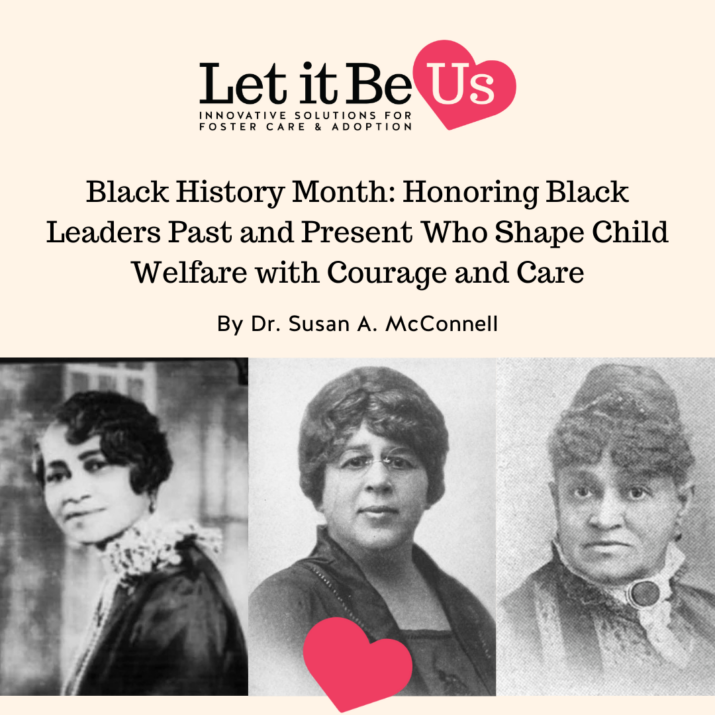
Janie Porter Barrett (1865–1948) founded the Virginia Industrial School for Colored Girls in 1915, creating an alternative to incarceration that centered education, dignity, and rehabilitation for Black girls at a time when punishment was the norm [5]. Her work helped shift child welfare thinking from control to care.
Fredericka Douglass Sprague Perry (1872–1943), granddaughter of Frederick Douglass, was a juvenile court worker and co-founder of the Colored Big Sister Home for Girls, advocating for equitable foster care and health services for Black children excluded from mainstream systems [6].
Carrie Steele Logan (1829–1900), born into slavery and orphaned herself, founded what became the nation’s first Black orphanage. Her work created safety, stability, and opportunity for children who were otherwise invisible to public systems [7].
Dorothy Irene Height (1912–2010), longtime president of the National Council of Negro Women, advanced policies and programs that strengthened Black families through education, economic opportunity, and social supports, work that remains deeply connected to child and family well-being today [8].
These women did more than respond to crisis; they built community-based solutions grounded in love, accountability, and belief in children’s potential.
Contemporary Black Leaders Strengthening The Foundation
Black leadership in child welfare is not confined to history, it is alive, evolving, and urgently needed.
Dr. Starsky Wilson, President and CEO of the Children’s Defense Fund, continues a national legacy of advocating for children’s rights and addressing racial inequities across child welfare, education, health, and juvenile justice systems [9].
Monique Couvson, President and CEO of Grantmakers for Girls of Color, has mobilized philanthropic investment to center the leadership, safety, and opportunity of Black girls and gender-expansive youth—groups often overlooked in child welfare conversations [10].
DeJuana Jernigan, MSW, LCPAA, President and CEO of Arms Wide, leads national efforts to support older youth in foster care through mentoring, adoption, and culturally affirming permanency practices [11].
Mario Johnson, a national leader with Casey Family Programs, works to transform child welfare systems toward racial equity, family integrity, and prevention-focused models that reduce unnecessary family separation [12].
Together, these leaders carry forward the legacy of earlier pioneers by pushing systems to listen, adapt, and center families.
Authors and Scholars Reshapeing How We Understand Child Welfare
Black authors and scholars have also profoundly influenced how the field understands race, trauma, and family support.
Dr. Dorothy Roberts, author of Torn Apart, argues that the child welfare system often functions as a mechanism of family separation rather than support for Black families, calling for a fundamental reimagining of how society responds to family needs [3].
Dr. Riana Elyse Anderson, a clinical psychologist, studies racial stress and resilience in Black families and developed the EMBRace framework to support healthy parent-child relationships in the context of racialized trauma [13].
Dr. Dexter Voisin, a social work scholar, has contributed extensive research on trauma, community violence, and resilience among Black youth, emphasizing the importance of culturally responsive, community-based interventions [14].
Drs. Ramona Denby and Carla Curtis, co-authors of African American Children and Families in Child Welfare, provide a comprehensive, practice-oriented framework for improving outcomes through culturally grounded, family-centered approaches [15].
These scholars remind us that equity in child welfare is not theoretical, it is evidence-based, relational, and achievable when systems are willing to change.
Honoring Black History Month Through Action
Honoring Black leadership in child welfare means more than recognition, it requires commitment. It means:
- Elevating Black voices in decision-making roles
- Using data to confront racial disparities honestly
- Designing systems that support families before they fracture
At Let It Be Us, we believe that permanency is strongest when children remain connected to their families, cultures, and communities. This Black History Month, we honor the leaders, past and present, who continue to remind us that child welfare, at its best, is about relationships, dignity, and justice.
References
[1] U.S. Department of Health & Human Services. AFCARS Report.
[2] Wildeman, C., & Emanuel, N. (2014). Cumulative risks of foster care placement by race/ethnicity. PNAS.
[3] Roberts, D. (2022). Torn Apart: How the Child Welfare System Destroys Black Families. Basic Books.
[4] Cross, T. L., et al. (2011). Culturally responsive systems of care. Child Welfare.
[5] Barrett, J. P. Historical accounts of the Virginia Industrial School for Colored Girls.
[6] Fredericka Douglass Sprague Perry biographies and juvenile court reform histories.
[7] Generations United. History of Black orphanages and kinship care.
[8] National Women’s History Museum. Dorothy Height biography.
[9] Children’s Defense Fund. Leadership and mission overview.
[10] Grantmakers for Girls of Color. Organizational impact reports.
[11] Arms Wide. Leadership and permanency initiatives.
[12] Casey Family Programs. Racial equity and systems transformation.
[13] Anderson, R. E. (2018). EMBRace intervention framework.
[14] Voisin, D. R. (2018). Trauma and resilience among Black youth.
[15] Denby, R., & Curtis, C. (2013). African American Children and Families in Child Welfare.
[16] American Academy of Pediatrics. The impact of racism on child and adolescent health.
About Let It Be Us:
Let It Be Us is a nonprofit organization dedicated to recruitment, matching and placement within foster care and adoption across the State of Illinois. Through innovative programming and strategic partnerships, Let It Be Us aims to improve outcomes for children in the child welfare system. Learn more at www.letitbeus.org.
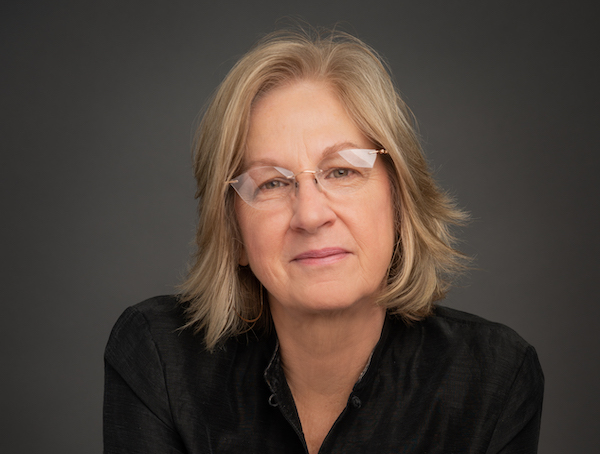
Dr. Susan A. McConnell is the Founder and Executive Director of Let It Be Us, an Illinois licensed child welfare agency with the mission of providing collaborative, innovative solutions of effective recruitment and placement within Illinois foster care and adoption. Susan has an MBA from DePaul University and a Doctorate Degree in Social Work from the University of Southern California, where her work focused on permanency within child welfare. She is the Chair of the Permanency Committee of the Illinois Statewide Foster Care Advisory Council, appointed by the Director of the Illinois Department of Children and Family Services (DCFS) in 2017. She is also an adoptive parent with over 30 years of open adoption experience. She can be reached at susanmcconnell@letitbeus.org.
Let It Be Us is an Illinois 501(c)3 and licensed child welfare agency. The mission of Let It Be Us is to provide collaborative, innovative solutions of effective recruitment and placement within Illinois foster care and adoption. The Let It Be Us platform manages the Adoption Listing Service of Illinois and the Heart Gallery of Illinois, engines of success for Illinois foster care adoptions. The Let It Be Us vision is for all children in the Illinois child welfare system to achieve educational equity, employment equity, and overall well being through the incorporation of Let It Be Us Programming into statewide advancements in foster care and adoption recruitment and placement. For more information about Let It Be Us, visit www.letitbeus.org.